
Locally Adapted Honey Bees (Apis mellifera)
This is the first post in a series looking at breeding our own East Yorkshire Bees without bringing imports from elsewhere in the world or or our own country.
This first post looks at why we should want to keep locally adapted bees and what exactly ‘local’ means.
Locally adapted honey bees, commonly called ecotypes, are populations whose genetic architecture has been refined over successive generations by regional climate, native flora, and localised pathogen pressure (Büchler et al., 2014). Unlike imported commercial stocks bred in uniform climates, local bees exhibit genetic adaptations that optimise colony survival and resource conservation for their area.
1. Key Benefits and Biological Variations
Overwintering and Colony Survival
Locally adapted honey bees exhibit significantly lower winter losses and longer life expectancy under local environmental conditions. The multi-country COLOSS Genotype–Environment Interaction (GEI) study tracked 621 colonies across Europe without chemical treatments and established that local colonies survived 83 days longer on average than non-local colonies in the same apiaries (Büchler et al., 2014; Francis et al., 2014).
Climate and Flight Adaptation
Northern adapted ecotypes—predominantly descended from the Dark European honey bee (Apis mellifera mellifera)—possess physiological mechanisms tailored to cold, wet climates:
- Flight Thresholds: Local dark bees fly at ambient temperatures of 10°C or lower, under overcast skies, and in windy conditions where southern imported strains (e.g., Italian A. m. ligustica) remain clustered (Parker et al., 2010).
- Metabolic Adjustment: Proteomic analyses (analysis of the full set of proteins produced or modified by an orgasnism) show an increase in the abundance of specific proteins linked to flight-muscle heat production in northern ecotypes during cold periods (Parker et al., 2010).
Resource Frugality and colony growth regulation
Local bees tune brood production directly to regional nectar and pollen availability:
- Brood Regulation: During mid-summer nectar dearths or unseasonal spring cold snaps, local queens reduce laying. In contrast, non-adapted commercial strains often maintain high brood rates, leading to rapid starvation without sugar feeding.
- Winter Consumption: Local stocks form tighter, highly efficient winter clusters that consume honey stores slowly, reducing the risk of starvation and gut disorders like dysentery during long winters.
Pathogen Resistance and Biosecurity
Co-evolution with local variants of Varroa destructor, Nosema, and viral complexes yields higher baseline tolerance through behavioural traits like hygienic removal of infected pupae and increased grooming behaviour (Meixner, Kryger and Costa, 2015). Avoiding live queen imports also prevents the introduction of exotic pests and diseases. A stance that BBKA is strongly promoting.
2. Local?
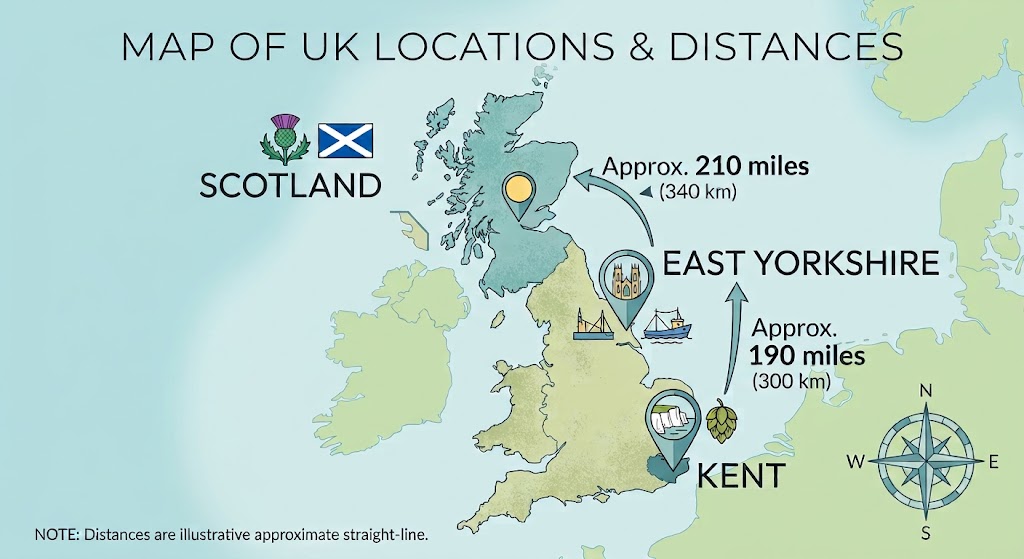
It is easy to think of local on an international scale and it is clear that Italy, for example, is a very different proposition for honey bees than wet windy UK. However, the United Kingdom spans sharp climatic gradients over short distances. A colony adapted to southern maritime conditions will encounter severe physiological challenges if relocated north.
The table below identifies some of the differences encountered in three UK locations.
| Factor | Kent (South East) | East Yorkshire (Mid-North) | Scotland (Highlands & Lowlands) |
| Climate Profile | Warmer, semi-continental, longer foraging season | Cool coastal winds, drier, moderate spring buildup | Cold, wet maritime, short summer, long winter |
| Primary Forage | Orchard fruit, oilseed rape, prolonged summer flora | Early oilseed rape peak, beans, late heather | Spring willow/gorse, main late Ling heather (Calluna vulgaris) |
| Spring Buildup | Early and rapid (March–April) | Moderate; delayed by cold easterly coastal winds | Late (May–June); conservative laying until weather settles |
| Summer Dearth Behaviour | Minimal dearth; steady continuous nectar flow | Sharp July dearth; local bees pause laying to save stores | Weather-dependent; brood tied strictly to late heather flow |
| Winter Dynamics | Milder; looser cluster; higher winter honey burn | Damp and windy; compact cluster; moderate honey burn | Long, dark; extremely tight cluster; highly frugal honey burn |
| Dominant Genetics | High proportion of imported commercial hybrids | Hybrid zone; mix of imported lines and local dark strains | Stronghold of native/near-native A. m. mellifera |
3. Practical Implications for Beekeepers
- Reduced Management Input: Locally adapted colonies require less artificial feeding during summer dearths and unseasonal weather events.
- Reduced Winter Losses: Matching bee genetics to regional winter duration and humidity significantly lowers winter colony collapse rates.
- Targeted Selection: Rearing queens locally from top-performing, winter-hardy hives preserves beneficial gene complexes tailored to the local microclimate.
References
Büchler, R., Costa, C., Hatjina, F., Andonov, S., Meixner, M.D., Le Conte, Y., Uzunov, A., Berg, S., Bienkowska, M., Bouga, M. and Drazic, M. (2014) ‘The influence of genetic origin and its interaction with environmental effects on the survival of Apis mellifera L. colonies in Europe’, Journal of Apicultural Research, 53(2), pp. 205–214. Available at: https://doi.org/10.3896/IBRA.1.53.2.03.
EurBeST (2021) European Partnership on Honey Bee Selection and Resistance: Final Report. Brussels: European Commission.
Francis, R.M., Kryger, P., Meixner, M.D., Bouga, M., Ivanova, E., Andonov, S., Berg, S., Bienkowska, M., Büchler, R. and Charistos, L. (2014) ‘The genetic origin of honey bee colonies used in the COLOSS Genotype-Environment Interactions Experiment: a comparison of methods’, Journal of Apicultural Research, 53(2), pp. 188–204. Available at: https://doi.org/10.3896/IBRA.1.53.2.02.
Meixner, M.D., Kryger, P. and Costa, C. (2015) ‘Effects of genotype, environment, and their interactions on honey bee health in Europe’, Current Opinion in Insect Science, 10, pp. 177–184. Available at: https://doi.org/10.1016/j.cois.2015.05.010.
Parker, R., Melathopoulos, A.P., White, R., Pernal, S.F., Guarna, M.M. and Foster, L.J. (2010) ‘Ecological adaptation of diverse honey bee (Apis mellifera) populations’, PLoS ONE, 5(6), p. e11096. Available at: https://doi.org/10.1371/journal.pone.0011096.
Please do leave any comments or questions below