Bee Genetics — Local Queen Breeding & Gene Pool
At a Glance
- Breeding from your best local bees won’t ruin your gene pool — bees already share genes naturally across wide areas
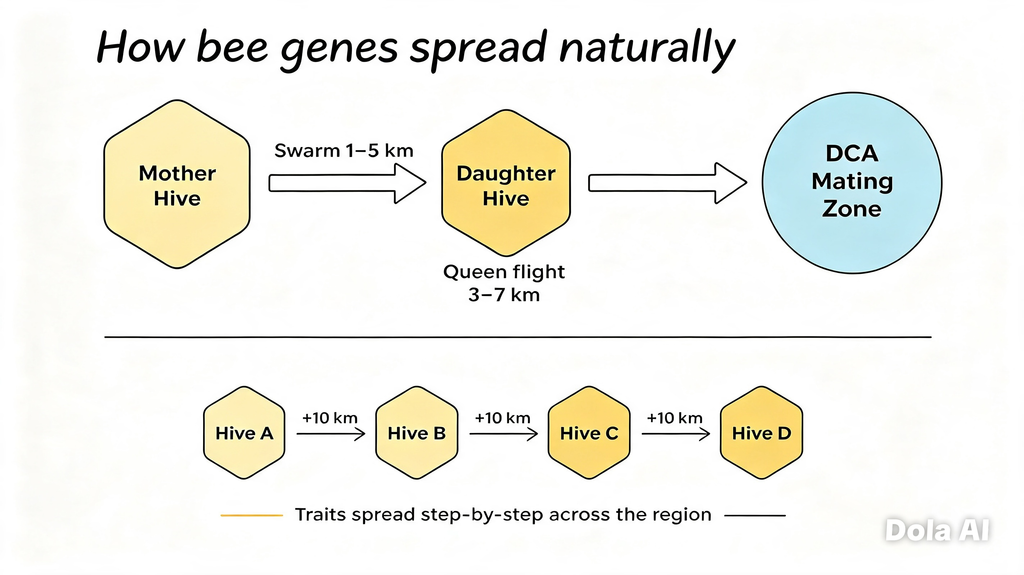
- Genes move in two steps: swarms shift colonies 1–5 km, then new queens fly another 3–7 km to mate
- Hives connect like a chain — useful traits pass gradually from one to the next, spreading across whole regions
- Nature keeps what works — hardiness, gentle temperament, and disease resistance spread; weaker traits fade out
- Your queens still mate widely — even locally raised queens fly out and mix with drones from dozens of hives
Understanding Bee Genetics: Will Local Queen Breeding Shrink Our Gene Pool?
It’s a question every beekeeper asks: “If I only breed from my best local queens, am I accidentally narrowing our gene pool or inbreeding my bees?”
It’s a sensible concern. The short answer is no. Honeybees have evolved a remarkable system for keeping their genetics mixed and diverse — naturally, across huge distances. Here’s how it works.
1. How Bees Spread Their Genes
Genes move in two distinct ways — through mating flights and through swarming.
A. Mating Flights
Mating happens at special places called Drone Congregation Areas (DCAs) — open spots where drones from all over gather waiting for queens.
- Drones fly 1–3 km to reach a DCA
- Virgin queens deliberately fly 3–7 km — past the nearest ones — specifically to avoid mating with relatives
- One mating event regularly links hives 2.5–5 km apart, sometimes up to 10 km in sparser areas
- A single queen mates with 10–20 drones, and a single DCA can draw in 15,000+ drones from 200+ colonies
B. How Far Does This Actually Cover?
- In one season, a single hive’s mating reach spans roughly 80–450 km²
- Add swarms and second-generation matings, and that same colony spreads its influence across over 700 km² in a single year
2. The Two-Step Genetic Relay
Every spring, genes travel farther than any single bee could ever fly — by working in two stages:
Step 1 — The Move: A swarm leaves the original colony and sets up home 1–5 km away. This physically moves the lineage to a new location.
Step 2 — The Mix: That new colony’s queen flies another 3–7 km to mate. Drones from that new hive also fly out in the opposite direction.
Combined: One season = 15–20 km of forward movement for that colony’s genes.
3. How Fast Do Genes Travel?
Take a straight-line distance like Edinburgh to Beverley — roughly 320 km:
| Route | Speed | Timeframe |
| 🐝 Natural relay | 6–10 km/year | 30–50+ years |
| 🐝 Ideal conditions | 16–24 km/year | 12–20 years |
| 🚚 Human-assisted | ~320 km/day | Under 24 hours |
Geography — hills, rivers, moorland — slows things down, but over decades, genes naturally move across entire countries.
4. The Stepping-Stone Effect
Genes don’t need to travel hundreds of miles in one go. They pass down the line:
A useful trait that appears in one apiary will slowly ripple outward, generation by generation. It only becomes established if it actually helps survival — better wintering, disease resistance, or better timing with local flowers. Traits that don’t help simply fade away.
What Blocks the Chain?
- Large barriers: Wide seas, high mountains
- Habitat gaps: Large areas with no bees — intensive monocultures, barren ground — break the chain
Final Takeaway
Your local bees aren’t an island. Unless you’re cut off by sea or high mountains, your hives are part of one vast, interconnected network stretching across the country.
Breeding from your best local queens? That’s good beekeeping, not genetic isolation. Those queens will fly out and mate widely. Their good traits will spread naturally. The wider gene pool keeps flowing in. You’re strengthening your local population — never shrinking it.
References
Collet, T., et al. (2009) ‘Genetic structure of drone congregation areas of Africanized honeybees’, Apidologie.
Koeniger, N., Koeniger, G., & Woyke, J. (2014) ‘A Comparative Study of Drone Flight Range and Congregation Areas’.
Moritz, R. F. A., et al. (2005) ‘Spatial structure of the genetic variation of honeybees (Apis mellifera L.)’.
Peer, D. F. (1957) ‘Further Studies on the Mating Range of the Honey Bee, Apis mellifera L.’, The Canadian Entomologist.
Ruttner, F. and Ruttner, H. (1972) ‘Untersuchungen über die Flugweite und das Paarungsverhalten der Drohnen’, Apidologie, 3(3), pp. 203–232.